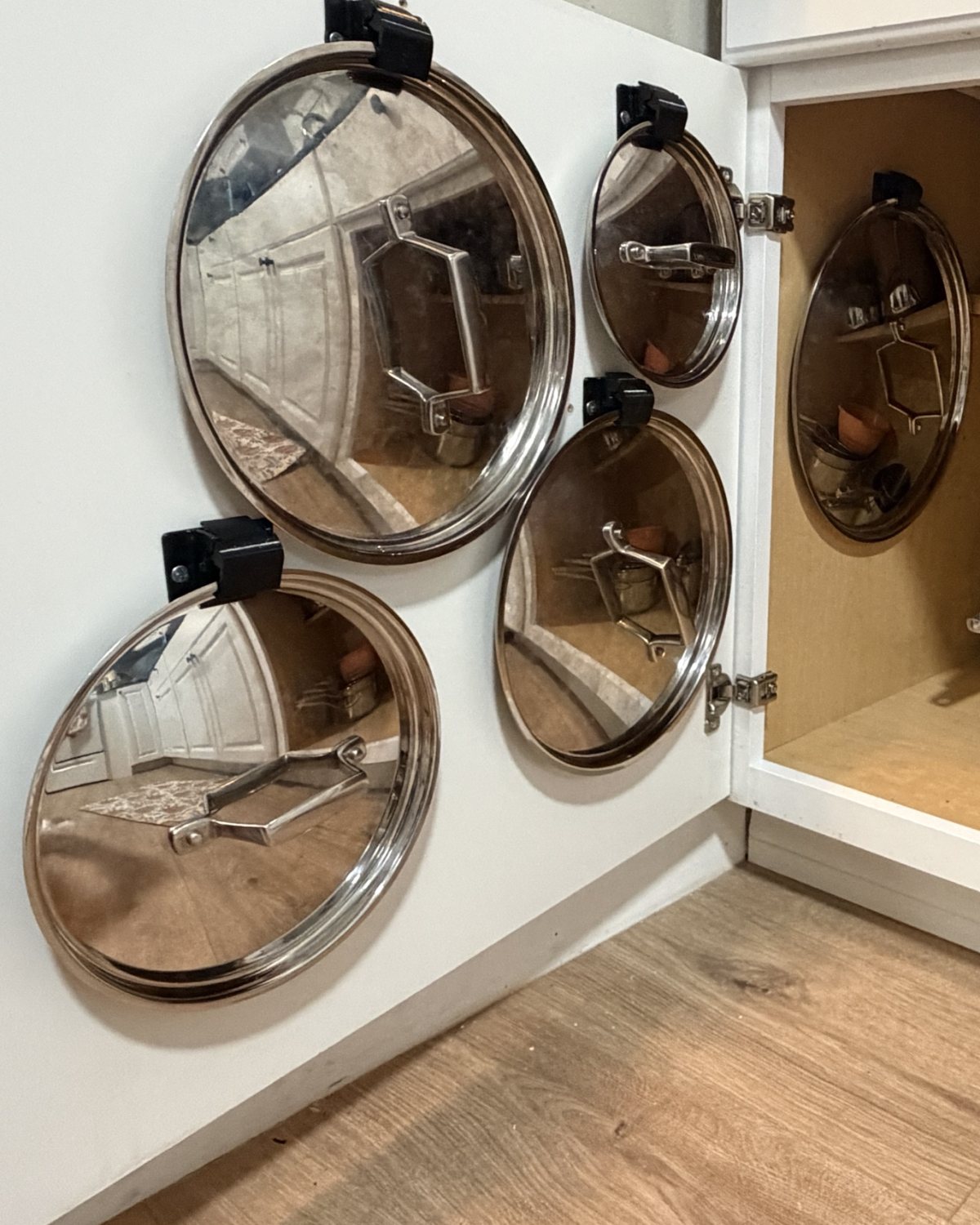
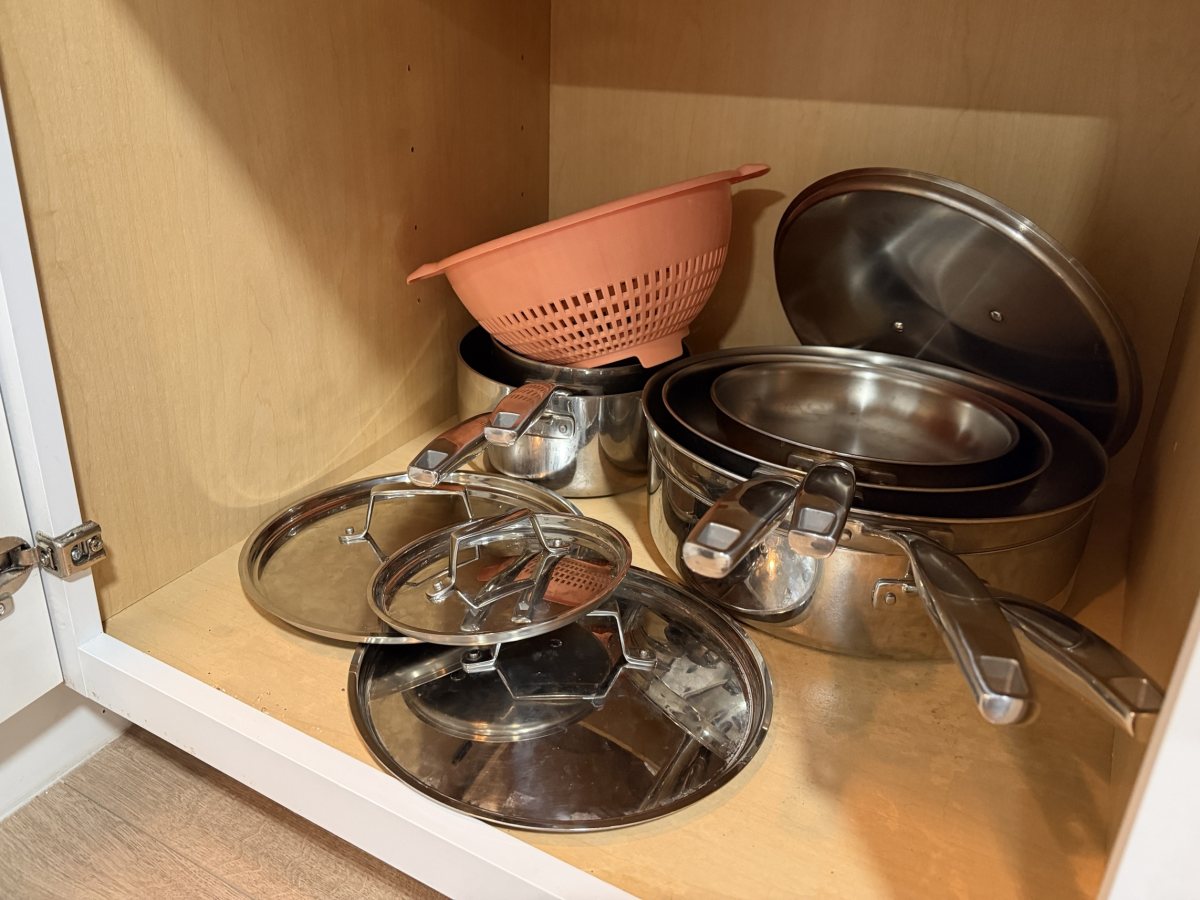
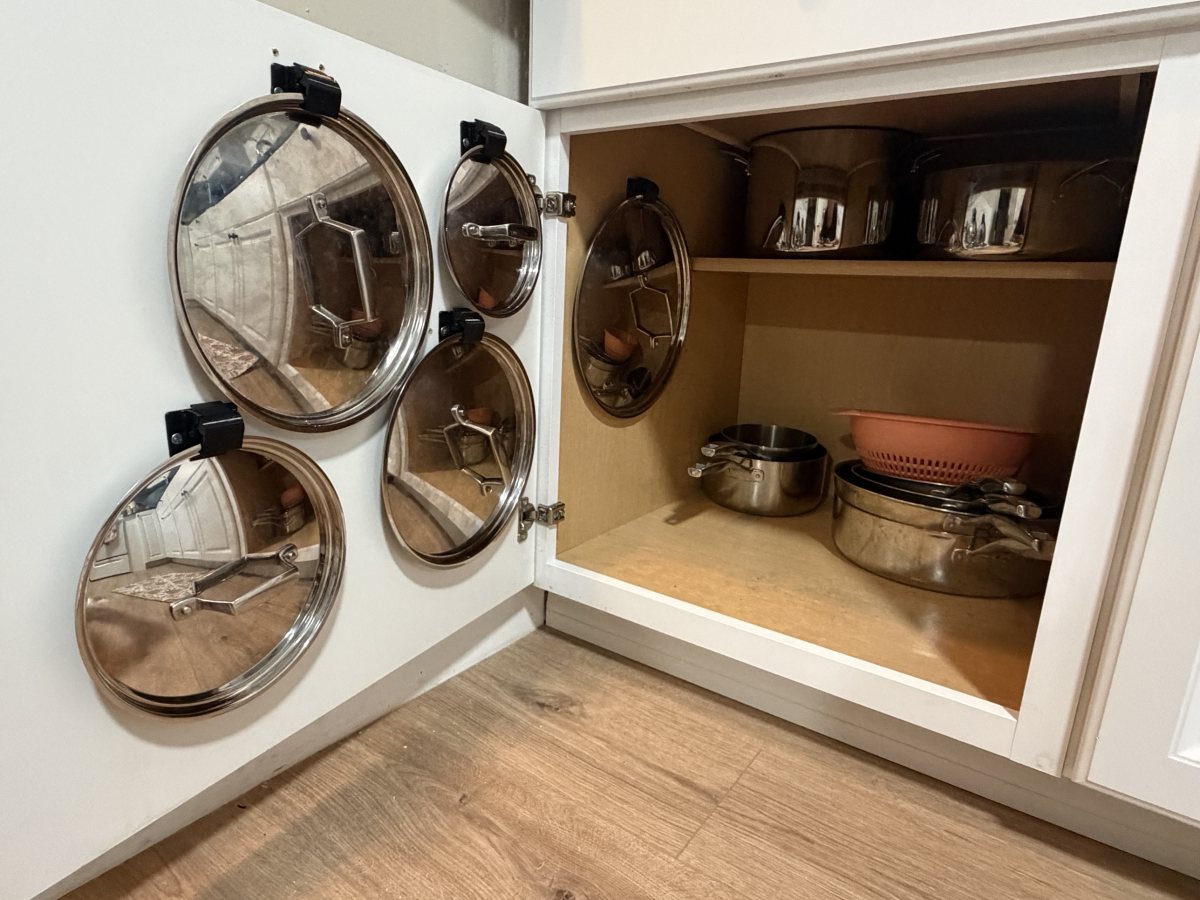
It started the way it starts in most kitchens: a cabinet where the pots were fine and the lids were a sliding, clattering pile. We wanted them on the inside of the door, one lid per spot, easy to grab. That turned out to be a harder problem than it looks.
The problem with fixed clips
Most lid clips are a fixed shape: a hook or a slot cut for one rim. That works if all your lids came from the same set. Ours didn't. A glass lid has a metal band around the edge, and the band's height changes from brand to brand. A stainless lid might have a flat top and a thin rolled rim. A clip shaped tightly enough to hold one lid lets the next one rattle, or won't take it at all.
So the goal became one clip that fits every lid we owned, glass and stainless, with no adjusting.
The prototype that failed
We went through a lot of printed versions. One of the more useful ones was a failure. It had a hinged catch with fixed stops, so the parts rested in set positions. On the test door, the glass lid slid right off: its bottom lip was taller than we'd planned for, so it barely touched the tooth meant to hold it. The stainless lid didn't come close to catching.
The lesson was simple. Any fixed position is perfect for one lid and wrong for every other. A lid a millimeter or two off the plan got no grip at all.
A jaw that finds the lid
The fix was to stop deciding where the lid would be. LidBay's jaw is one rigid part on a hinge pin, with two small steel springs behind it. There's no rest position it has to hit. The springs swing it in until it meets the lid, whatever size the rim is, and hold it there.
- Glass lids hang by their metal band on a row of stepped teeth, and the jaw presses them back so they can't hop off.
- Flat-top stainless lids sit on the jaw's toe, and their own weight pulls the jaw tighter.
- To take one out, lift a little, pull toward you and lower. The pull swings the jaw open, so it's one hand and one motion.
Made like hardware
The jaw is printed in place on its hinge pin, so there's nothing to assemble and nothing to work loose. Each clip slides onto its own mounting plate, and once the plate is screwed to the door, the door itself holds the latch shut. It can't be knocked off. To move a clip, take the two screws out and slide it up.
Every design gets the same test before it ships: lids on a door, and the door gets shaken and slammed. The current clip passed with glass and stainless lids hanging side by side.
What's next
LidBay is our own design from the first sketch to the springs, and we filed for a US patent in November 2026. Every clip is printed to order in PETG in Florida. If you have a lid that won't fit, email us. That's how the design got here.
Want the setup steps? The LidBay setup card has them in color. For other ways to tame the pile, see how to store pot lids.
LidBay is a spring loaded clip for the inside of a cabinet door. One clip per lid, glass or stainless, in packs of 4 and 6.
See LidBay